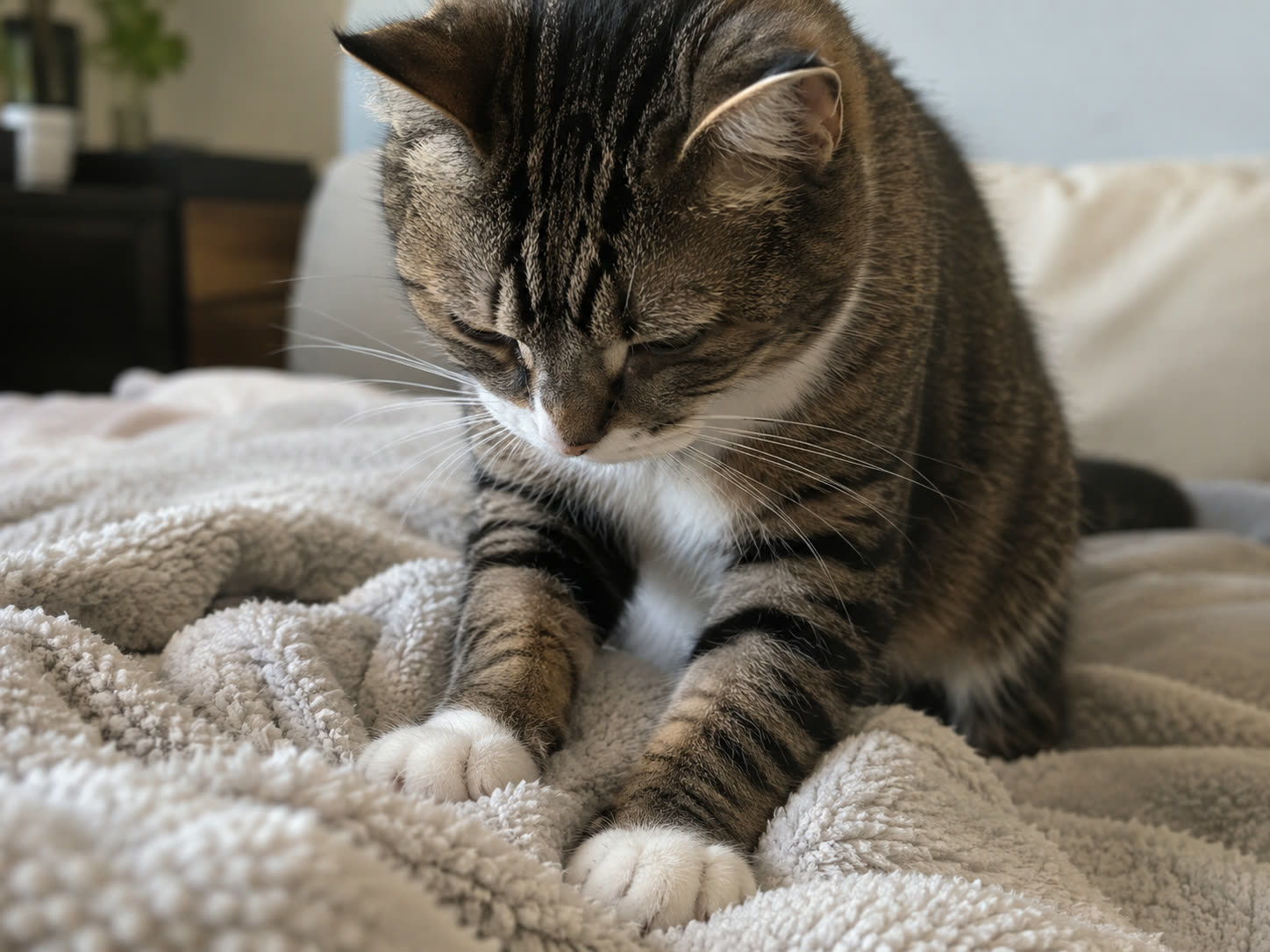
A reflex left over from nursing
Kittens knead the mother's side with both front paws to stimulate milk letdown while nursing, alternating one paw and then the other in a slow, steady rhythm. The motion works: kittens that knead get more milk, and they do it while warm, fed and pressed against something familiar. That combination sticks. Cats keep making the same motion as adults, usually in the same conditions: on a lap, a blanket, or another cat, right before or during a stretch of settling down to rest. It's less a single behavior than a leftover association. Paws working in and out once meant milk was coming, and for a lot of cats it still means something close to that.
The paws add a second layer to it. Cats have scent glands between their paw pads, so kneading a surface leaves a scent mark behind, the same mechanism behind why cats scratch one specific spot instead of any surface within reach. A cat that kneads the same corner of the same blanket every night isn't only comfortable there. It's re-marking a spot it already claimed.
What owners on OnlyMeows found
- Claws in usually means calm, claws out means something else. Most kneading came with retracted or barely-extended claws. When claws stayed out and dug in, it more often signaled overstimulation than contentment, the same shift in mood behind why some cats bite after licking.
- It clusters around settling in to sleep. Kneading showed up most right before a cat lay down for a nap, on a lap or a blanket, not as a random habit spread through the day.
- Purring and drooling often arrive together. Several owners described their cat kneading, purring and drooling at once, especially cats that were hand-raised or weaned very young. That specific combination tracks back to nursing more than to any single trigger in the room.
- Some cats only knead one object. A particular blanket or stuffed toy, never furniture or a person, was common enough that owners treated it as closer to a comfort object than a general habit.
- Older cats didn't grow out of it. Kneading didn't fade with age the way some kitten behaviors did. Several cats in their teens kneaded just as often as they had as kittens.
She's fourteen and still does the full routine on her blanket before bed, paws, purr, a little drool, exactly like she did at four months.
When kneading turns into fabric sucking
Kneading on its own isn't something to manage. It becomes a different question when a cat pairs it with sucking or chewing on wool, blankets or other fabric, instead of just pressing with its paws. The Cornell Feline Health Center describes this as wool sucking, most common in Burmese, Siamese and other Oriental-type cats, and notes it can point to a genetic predisposition similar to obsessive-compulsive disorders in people. VCA Animal Hospitals adds that the habit shows up more in cats weaned too early, since nursing gave them both food and comfort that ended before they were ready.
Neither source treats occasional wool sucking as rare or alarming by itself. The real risk is what happens if the cat swallows the fabric: both note that ingested wool or cloth can cause a gastrointestinal obstruction, which is a surgical emergency, not something to wait out.
When to see a vet
Kneading a blanket is not a symptom of anything. A cat that regularly sucks, chews or swallows fabric, especially a Siamese, Burmese or Oriental-type cat, or one weaned early, is worth a vet visit before it turns into an emergency. That's a different behavior from kneading, even though the two often show up side by side.