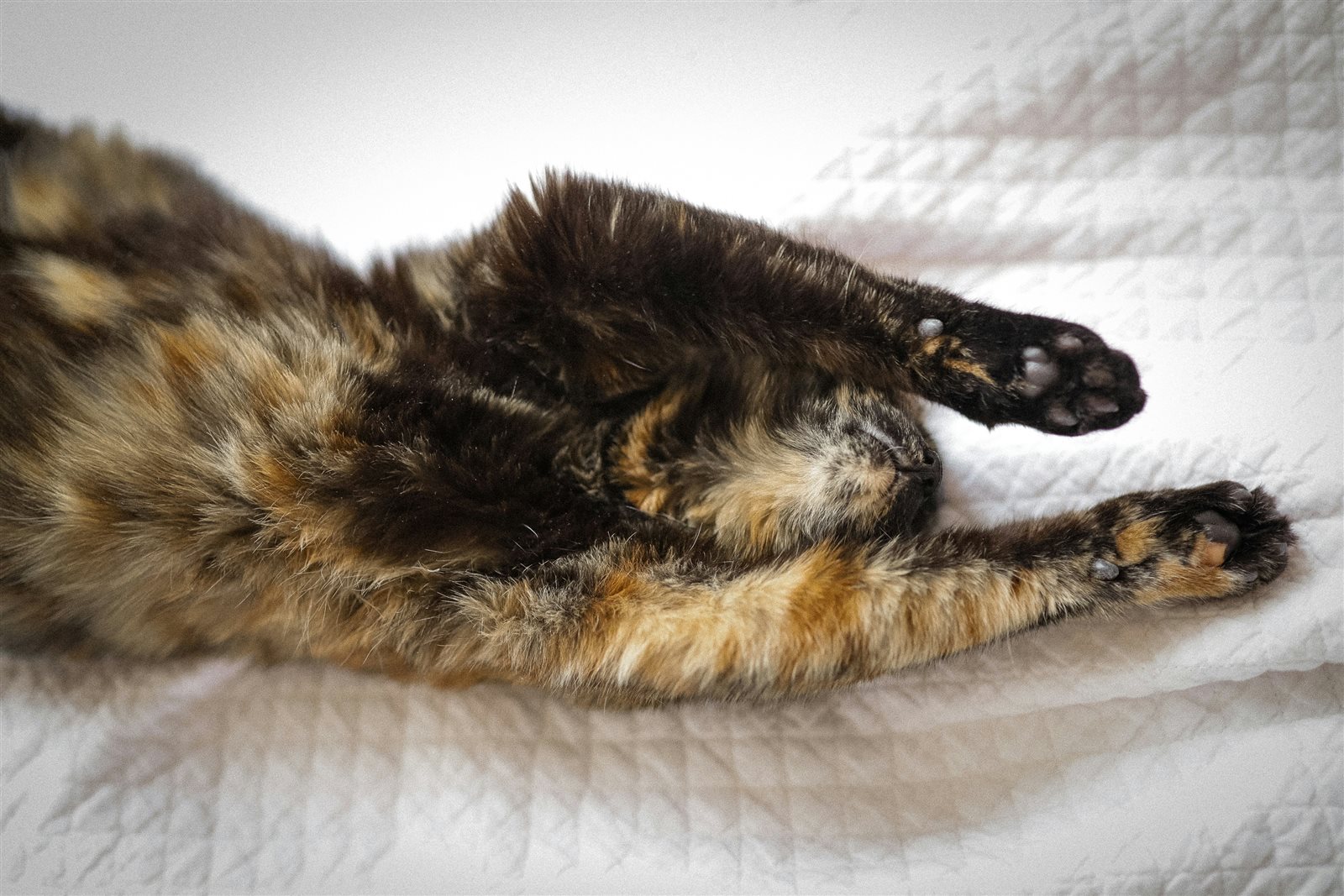
Purring isn't proof a cat is happy
A cat pressed against your hand, eyes half shut, purring, looks like the clearest signal there is. Most of the time it is. But the same sound comes from cats in labor, cats recovering from surgery, and cats too sick to do much else. Purring turns out to be less a mood report and more a tool cats use in several different situations, and the mechanism behind it was misunderstood for decades.
Key takeaways
- Purring comes from fibrous pads built into the vocal folds, not repeated signals from the brain, as researchers believed until a 2023 study tested it directly.
- Kittens purr within a couple of days of birth, before they can see or hear, as a way to stay in contact with their mother.
- A "solicitation purr", the one cats use to ask for food, has a higher-pitched sound folded into it that people find hard to ignore.
- Purring shows up in pain, stress and labor as often as it does in comfort, so it isn't a reliable sign that a cat feels fine.
The sound comes from tissue, not a nerve signal
For decades, the standard explanation was that a cat's brain sends rapid signals, dozens of times a second, to the muscles of the larynx, making them twitch in a steady rhythm that produces the purr. That would make purring an active process the brain has to keep running the whole time. A 2023 study from the University of Veterinary Medicine Vienna, published in Current Biology, tested that idea by removing cat larynges after death and passing air through them with no nerve or muscle activity at all. They still produced purring frequencies on their own.
The explanation turned out to be structural. Cats have pads of fibrous, fatty tissue built into their vocal folds, which lets the folds separate and come back together at a slow, steady rate, around 25 to 30 times a second, just from air moving past them. That's the low buzz you feel under your hand. It also explains something meows can't do: purring runs continuously through both breathing in and breathing out, instead of only on the exhale.
It starts before a kitten can see or hear
Kittens purr from about two days old, long before their eyes open. At that age they're guided almost entirely by touch and vibration, and purring works in both directions: a nursing kitten purrs against its mother, and she purrs back. It's a low-effort way to stay in contact and signal "still here, still feeding" without sight or distance calls. The same association carries into adulthood. A cat that purrs while kneading a blanket with both front paws, especially one that was hand-raised or weaned early, is running a version of that same nursing-linked comfort behavior, just aimed at an object instead of a mother.
The purr a cat uses to ask for something is different
Not every purr sounds the same to the cat producing it, and not every purr lands the same way with a person hearing it. A 2009 study from the University of Sussex recorded cats purring while soliciting food and compared those recordings to ordinary purring from the same cats. Hidden inside the solicitation purr was a higher-frequency component, closer in pitch to a cry, layered on top of the normal low rumble. When researchers played the recordings to people, including people with no cat of their own, the solicitation purrs were rated as more urgent and less pleasant than the plain ones, even at matched volume. Cats aren't consciously composing this, but the result is a sound that's harder to tune out right before a feeding time.
When purring means something other than contentment
Purring shows up with hissing, growling and meowing on the list of sounds cats make when something hurts. VCA Animal Hospitals notes that purring is not a reliable sign of a happy cat on its own, since cats also purr through pain, and points to a cat's evolutionary habit of masking weakness as one reason the two can look identical from the outside. The body language around the purr is usually the difference. A relaxed purr comes with soft eyes, loose muscles and slow blinking, the same calm state behind why some cats sleep pressed against you. A stressed or pain-related purr tends to come with a crouched posture, pinned ears, or a body that stays tense even while sitting still.
One idea that comes up often is that the purr's frequency itself helps a cat's body heal, since it falls in a range that's been shown to affect bone and tissue in other contexts. It's a genuinely interesting hypothesis, first floated over twenty years ago, but it hasn't been confirmed as something a cat's own body actually uses to heal faster. Worth knowing about, not worth treating as settled.
When to see a vet
Purring on its own is not a symptom. A sudden increase in how often a cat purrs, especially alongside hiding, reluctance to jump or climb, or a drop in energy, is worth a vet visit rather than an assumption that the cat is just extra content.