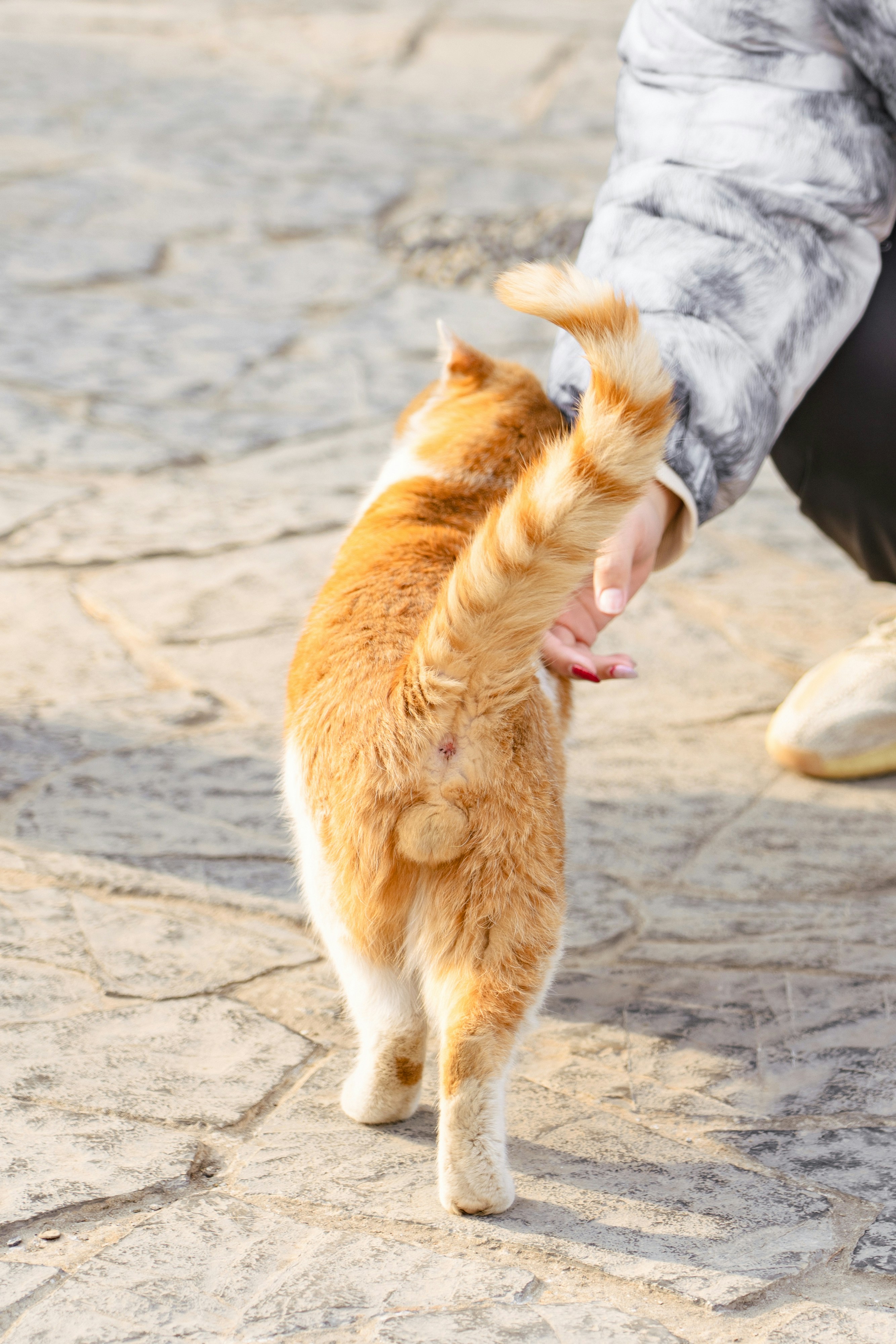
A headbutt is your cat putting its scent on you
When a cat bumps its forehead into your face or winds around your legs, it's marking you with its scent. Cats have scent glands on the chin, the sides of the mouth and cheeks, the sides of the forehead and along the tail, and rubbing those areas against something leaves a scent that other cats can read and people can't smell at all.
The head bump has a name, bunting. Between two cats the full-body version is called allorubbing, and it's something cats in the same household or colony do with each other, not with strangers. International Cat Care describes a cat rubbing around your legs at the door as the same greeting it would give another cat it lives with. So the short answer to "why does my cat headbutt me" is that it treats you as part of its group.
Key takeaways:
- Headbutting and rubbing leave the cat's scent on you. It's a sign of trust, and it usually happens when the cat is relaxed.
- Cats do it most at moments of reunion: when you come home, first thing in the morning, after a trip.
- Rubbing your legs when you walk in is a greeting first. It often turns into a request for food because food tends to follow.
- A cat that stops headbutting after years of doing it may not be feeling well.
- Pressing the head hard into a wall and holding it there isn't bunting. It's a sign of a neurological problem and needs a vet the same day.
Why it aims for your face, legs and hands
A bump to the face or chin
A headbutt to your face is the most direct version. The cat has to get close to your eyes and mouth to do it, which it only does with someone it feels safe with. Many cats follow it with a slow cheek rub along your jaw or beard, which is the cheek glands doing the work. VCA Animal Hospitals puts it plainly: headbutting isn't necessarily a sign of love, but it is a sign of trust, and cats also seem to use it to calm themselves.
Weaving around your legs
Legs are simply the part of you a cat can reach while you're standing. The usual sequence is a head bump on your shin, then the side of the body sliding along, then the tail wrapping around your leg at the end. That's the full allorubbing routine, done at the height available. It's usually done with the tail held straight up, which is its own friendly signal; the article on what your cat's tail is telling you covers what that position means.
Your hands, your phone, the corner of your laptop
A cat that shoves its cheek into your hand while you're typing, or rubs the edge of your phone, is marking the things you touch most. Objects in the "core" part of a cat's territory get the same treatment: chair legs, door frames, the corner of the bed. It also tends to happen when your attention is somewhere else, so part of it is a simple bid for attention.
When cats headbutt the most
The timing is the most useful clue, and owners describe the same moments again and again:
- When you come home. You've been out, you smell of other places, and the cat restores its scent on you. This is also why a cat often rubs most intensely after you've been to a vet, a friend's house or anywhere with other animals.
- First thing in the morning. A cat waking you with a head bump is mixing greeting, scent and "the food bowl is empty" into one gesture. If the morning version has turned into a 5am routine, the article on what actually reduced early morning wake-ups goes through what owners changed.
- After a trip or a change at home. New furniture, a move, a guest staying over: rubbing often goes up for a few days while the cat re-marks what feels unfamiliar.
- Between cats that get along. Cats in the same household rub heads and bodies when they pass each other. Scent swapping is also why the first stage of introducing cats to each other works through bedding and cloths before the cats ever meet.
What owners on OnlyMeows found
- Leaning in worked better than reaching out. Several owners noticed their cat headbutted more when they bent down and offered their forehead or cheek, and less when they reached out to pet the head. Letting the cat make the contact seemed to be the point.
- The rubbing at the door was about the owner, not only the food. When owners fed on a timer instead of right after coming home, their cats still rubbed at the door. The greeting stayed; the frantic part got shorter.
- A cat that "only headbutts one person" usually picked the one who moves slowly. In multi-person homes the cat often chose whoever sat on the floor, spoke quietly and let it come over, not whoever fed it.
- A drop in headbutting was the first thing some owners noticed before an illness. A few people only realised afterwards that the cat had stopped its usual bump in the morning a week or two before other signs showed up.
Head pressing is not headbutting
Head pressing looks nothing like a friendly bump once you know the difference. A cat that's head pressing walks up to a wall, a corner or a piece of furniture and pushes its forehead against it, then stays there, often for minutes, without any rubbing or purring. It isn't aimed at a person and there's no back-and-forth movement.
This is a sign that something is affecting the brain, and it needs a vet the same day. The Merck Veterinary Manual lists head pressing among the signs of liver disease affecting the brain, alongside circling, aimless wandering, drooling and poor coordination. Toxins and infections of the nervous system can cause it too. If you see it, note how long it lasts and film it if you can, then call your vet.
A smaller but real change worth mentioning to a vet: a cat that used to headbutt you every day and has quietly stopped. On its own it doesn't mean much, but together with eating less, hiding or sleeping in new places, it's a signal to have the cat checked.