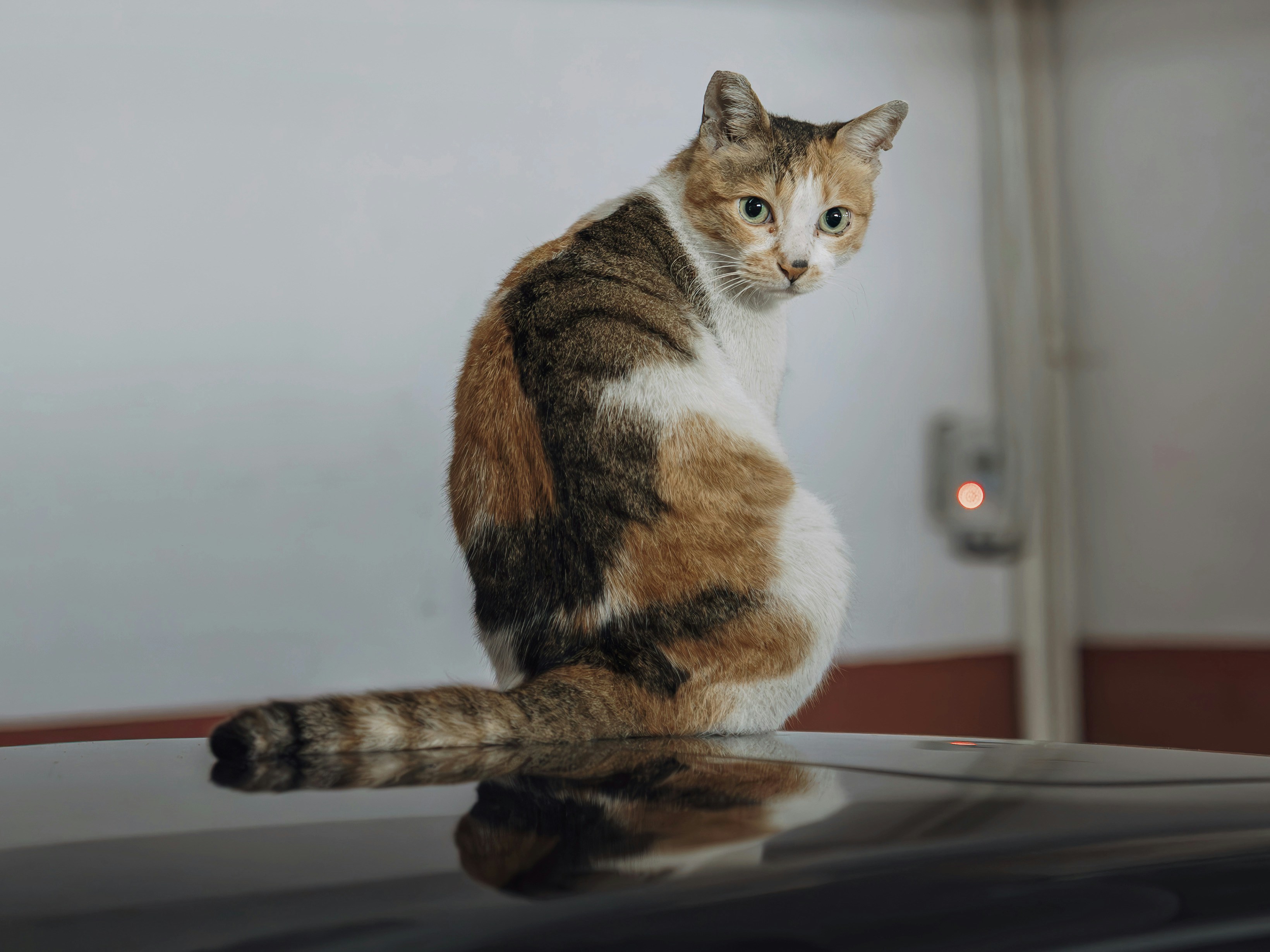
A cat's tail isn't a dog's tail
The most common mistake owners describe is reading a moving tail the way they'd read a dog's. In dogs a wag usually means a friendly mood. In cats, a tail swinging side to side usually means the opposite: something is bothering the cat, and the faster and wider the swing, the more it's bothered.
The second mistake is reading the tail alone. The same low tail can mean a relaxed cat strolling across the room or a frightened one creeping toward cover. What separates them is everything else: ears, body height, and what just happened. International Cat Care makes the same point: the tail is one signal among several, and the eyes, ears, mouth and whole-body posture change its meaning.
Key takeaways:
- Tail straight up is a friendly greeting, to people and to other cats.
- A tail swishing or thumping is irritation or frustration, not happiness.
- A puffed tail is fear or defence, and the cat wants distance.
- A tucked or wrapped tail on a crouched cat means it's trying to look small.
- A tail that suddenly hangs limp and doesn't move is a vet visit.
What the main tail positions mean
Straight up, sometimes with a hooked tip
A vertical tail is the clearest friendly signal a cat has. It's what a cat does when it walks up to you at the door, and what cats in the same group do when they meet. In an observational study of free-ranging cat colonies, Cafazzo and Natoli found the tail-up display was used mainly toward cats from the same social group and went together with friendly behaviour such as nose touching and rubbing. It likely starts in kittenhood, where a raised tail is how kittens approach their mother.
The small hook at the top that makes the tail look like a question mark shows up often in play. Owners mostly see it when a cat is about to pounce on a toy or bounce off sideways.
Low, tucked or wrapped around the body
A tail carried low while walking is often just a relaxed cat. It means something different when it's tucked under the body or wrapped tight around a crouched cat. That's a cat making itself small, and it usually comes with flattened ears and wide eyes. If this is what you see most days, the article on signs of cat anxiety and what actually helped goes through what owners changed at home.
A tail wrapped loosely around a cat sitting upright, eyes half closed, is a different thing. That's a cat keeping warm and comfortable, not one that's scared.
Puffed up
A tail puffed to twice its size is the hair standing on end to make the cat look bigger. With an arched back and a sideways stance, it's a "stay away" signal. Owners see it most after a sudden noise, a strange cat at the window, or a new cat being introduced too fast. The only useful response is to give the cat space and let it calm down on its own; reaching for it while it's puffed is how people get scratched.
What the movement means
A slow swish or a thumping tail
A tail held out and moving slowly from side to side often means frustration: the cat wants something it can't get, or is putting up with something it doesn't like. A tail thumping on the floor or the sofa while the cat lies still is a stronger version of the same thing.
This is the signal owners most often miss during petting. The tail starts flicking a few seconds before the cat turns and nips, and stopping at the first flick usually avoids the bite. The article on why a cat licks you, then bites you covers the rest of the warning signs that come with it.
A twitching tip
A tail held still with only the tip twitching usually means focus. It's the tail of a cat watching a bird through the window or a toy under the sofa, and it often comes right before a pounce. On its own it's not irritation; paired with flattened ears and a stare at your hand, it can be.
A quivering tail held straight up
A raised tail that vibrates at the base usually comes with an enthusiastic greeting, often when food or a favourite person arrives. The same quiver, with the cat backing up to a wall or a door, is also what spraying looks like. Where the cat is standing tells you which one it is.
What owners on OnlyMeows found
- Watching the tail during petting cut the bites almost entirely. Several owners who thought their cat "bit out of nowhere" noticed the tail had been flicking for a while before it happened. Once they stopped at the first flick, the bites mostly went away.
- Tail up at the door wasn't only about food. Owners noticed their cat greeted them tail up even after it had eaten, and did the same with the other cat in the house when they got along.
- The tail showed how an introduction was going before anything else did. Between two cats, raised tails meant it was safe to keep going, while a puffed or lashing tail meant going back a step. The guide on how to introduce cats to each other goes through those steps.
- Each cat has its own baseline. Some cats flick their tails through a whole calm evening on the couch. What owners learned to watch for was a change from that cat's usual, not a rule from a chart.
When the tail itself is a vet question
A tail that suddenly hangs limp and doesn't move is worth a vet visit the same day. Tails get pulled, or caught in a closing door, and VCA Animal Hospitals notes that a hard pull can stretch or tear the nerves at the base. The same nerves control the bladder and bowels, so a limp tail together with accidents outside the litter box points to an injury, not a mood. The same goes for a cat that suddenly won't let you touch its tail, or keeps chasing and biting at it. That can point to pain or a skin problem at the base of the tail, which is worth having a vet look at rather than waiting.